 |
BiographyOn arrival, TFL was lured to the goldfields in Castlemaine, Victoria, though many years had passed since the gold rush in this area. Due to a high demand for adult education at this time, TFL gained a position with Castlemaine's School of Mines (operating throughout Victoria - later renamed Technical Schools), and began instructing in building construction and geometrical drawing. Intrigued by the local people's interest in art, he also opened classes in painting, etching and design. Due to the success of his art classes, TFL was soon asked to open a second art school in the nearby town of Kyneton. Classes were initially conducted at Kyneton's Mechanics Institute (still in use today), and later at the School of Mines building in Piper Street (opposite the steam mill - formerly Trio Station Winery). In 1892, at the age of 28, "the little Englishman"--as he was known in Kyneton--married Lousia Taylor of nearby Pipers Creek. They took up residence at "The Pines" in Castlemaine, where Louisa's father and uncle had made their fortune, having discovered gold at the satellite town of Chewton. In contrast to the prosperity of the 1880's, the depression of the 1890's caused great hardship throughout rural Australia. Consequently, TFL, Lousia and their two children (Harry and Tom), left Australia for Europe, where TFL intended to study and practice in the art centres of England and France. Whilst in England, TFL proved to be a leader in results at the London College of Art, and during this period he won the much sought after National Medal for Design. The family subsequently moved to France, but the approaching birth of a third Levick child (George) prompted a return to Australia. By 1902, the family had moved to Kew, Melbourne. Having furthered his qualifications in Europe, TFL set about establishing an art school in Melbourne. He persuaded the Mayor of Prahran (Naylor) to use his influence to open a Technical School (now Swinbourne Tafe, Prahran Campus). Initially TFL conducted all classes, including drawing, painting, repousse, architecture, building construction and design. Once the Prahran school was well established, TFL became involved with Melbourne's Working Men's College (now RMIT). During 1905, the Levick family returned to Kyneton, while--as a gesture to the Freemasons--TFL worked on the murals at the Kyneton Masonic Lodge (PDF 1.13 MB) (see also Heritage Council of Victoria and Imhotep Today: Egyptianizing Architecture). TFL and Louisa soon purchased 'Gwandoban' in Donnithorne Street, Kyneton, and lived there until 1910, when TFL resumed his undertakings with the Working Men's College and the family moved to Glenhuntly Road, Elsternwick (shortly after the birth of fourth son John). By 1912, the family had once again returned to Kyneton. TFL briefly engaged himself with art instruction in the town, but soon began a full-time association with the Working Men's College in Melbourne. Taking up a flat with his son Harry at Oxford Chambers in Bourke Street, TFL spent the working week in Melbourne, and travelled home to Kyneton at weekends. By 1917, TFL had become the head of the Art School at the Working Men's College. However, he was not so well suited to this administrative role, and so later worked under an English expert in art instruction named Carew-Smythe. Louisa and TFL had received a property in Pipers Creek (Rosebery) from Louisa's father, as part of their marriage settlement. It was here in 1916, that a house of TFL's design was built by a carpenter/cabinet maker (Merritt), with TFL heavily involved in planning and construction. Gwandoban was later sold and the family moved to Rosebery. Eventually retiring to Rosebery, TFL was visited regularly by friends and associates. Among these were the highly regarded artists W.D.Knox and J.H.Sheltama-the latter a companion on several painting expeditions to Port Campbell. In his later years, TFL participated in many community projects in Kyneton, their implementation often aided by his friend James Maxwell, the then Shire Engineer. These projects include:
In 1933, leaving their newly married son John to farm Rosebery, TFL and Louisa moved to Bowonga in Epping Street Kyneton (designed and constructed in part by TFL, but since demolished). TFL and Louisa lived at Bowonga until TFL's death in 1945. 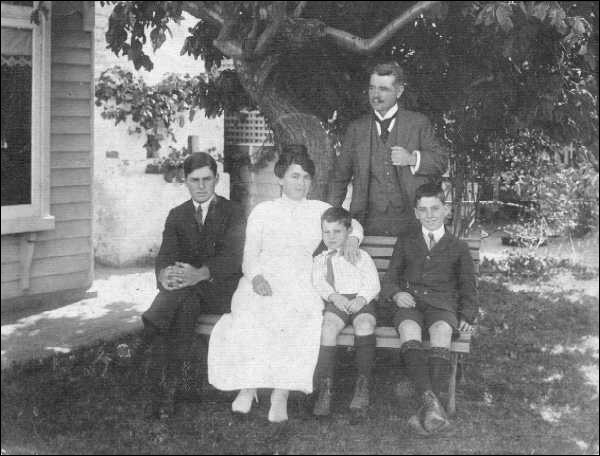 The Levick Family at Gwandoban (from left): Harry, Louisa, John, TFL and George |
|
Home || Gallery | Biography | Contact | Links || Back to top
 |